Graph paper/5 mm
5 mm graph paper
The metric standard · also called 5 mm grid or squared paper · free, true to size, no sign-up
Direct PDF link for sharing or scripts: printgridpaper.com/api/pdf?size=5mm&paper=a4
The ruling inside almost every school exercise book outside North America. It is standard for a reason that is easy to miss: 5 divides both 210 and 297 exactly, so a 5 mm grid and an A4 sheet were made for each other.
Why 5 mm became the metric default
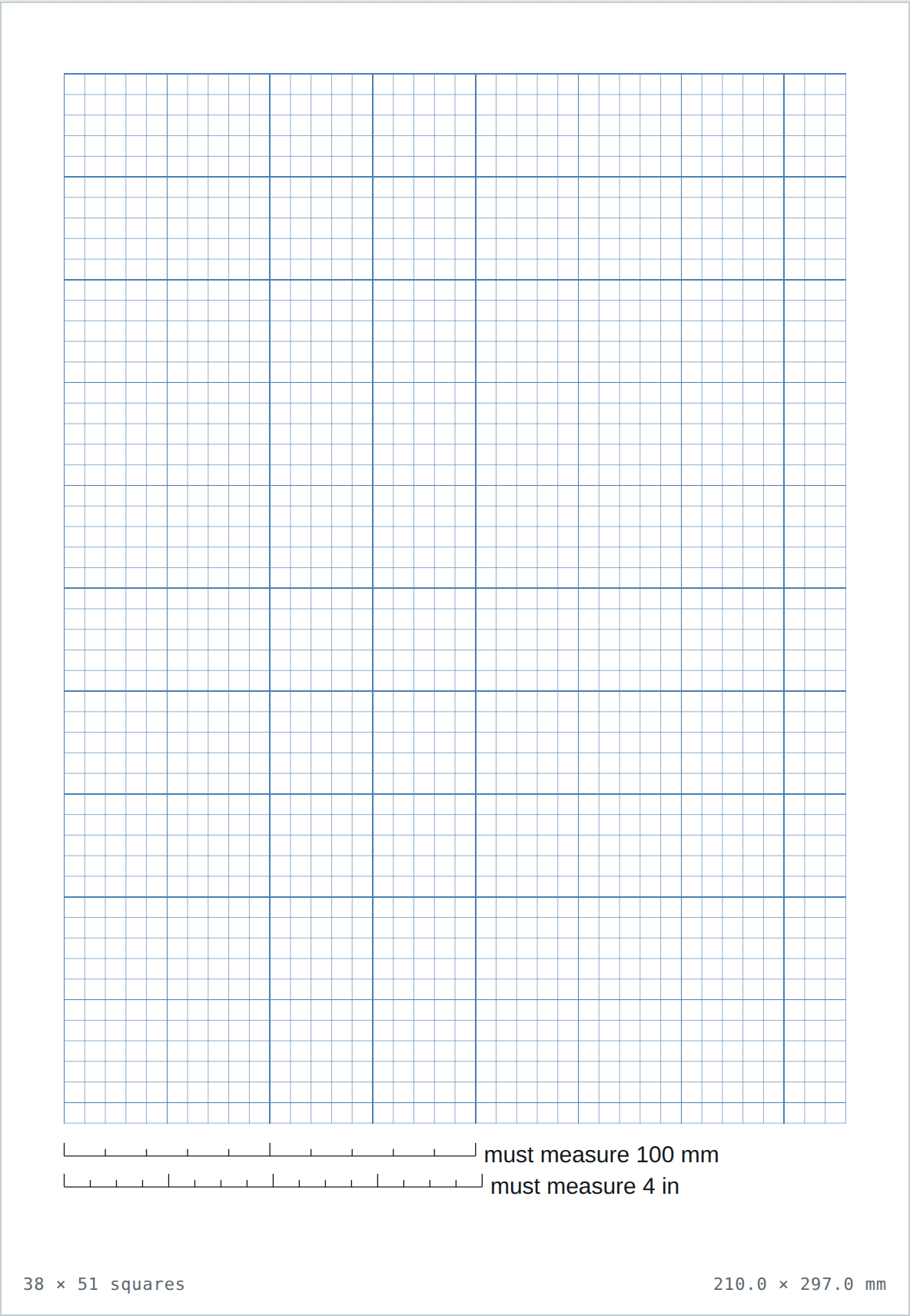
Twenty squares make 10 centimetres, so the grid is a ruler you can read without one. Bold every fifth line and each block is 25 mm; bold every tenth and each block is 5 cm. Both conventions are in use and both are one field change away below.
| Paper | With measuring bars | Clean sheet | Grid area |
|---|---|---|---|
| Letter | 39 × 48 — 1,872 | 39 × 51 — 1,989 | 195 × 240 mm |
| A4 | 38 × 51 — 1,938 | 38 × 55 — 2,090 | 190 × 255 mm |
| Legal | 39 × 63 — 2,457 | 39 × 67 — 2,613 | 195 × 315 mm |
| A5 | 25 × 34 — 850 | 25 × 38 — 950 | 125 × 170 mm |
| Tabloid | 51 × 78 — 3,978 | 51 × 82 — 4,182 | 255 × 390 mm |
A4 is its home paper. On Letter the sheet is 5 mm wider and 18 mm shorter than A4, so you gain a column and lose three rows. Nothing is wrong when the numbers move; the paper changed shape, not the grid.
Where 5 mm is the size people expect
Outside the US, this is what "graph paper" means with no further qualification. Most of the uses below assume a square is a fixed physical 5 mm rather than an abstract unit.
School exercise books
The default ruling for maths and science across Europe, Japan, China, India and Australia. If a teacher asks for squared paper and does not specify, this is what they picture.
Lab and science plotting
Fine enough to plot a real data range on one page, coarse enough to write a value beside a point. The 25 mm bold blocks work as natural axis divisions.
Bullet journals and planners
Squared pages are the usual alternative to dot grid for anyone who wants visible structure. Print it on A5 for a notebook-sized insert.
Technical sketching
Small enough that a freehand line still reads as straight, which is why it is the standard for quick dimensioned sketches before anything gets drawn properly.
Perler and Hama bead patterns
Standard midi beads sit on a 5 mm pitch, so one square is exactly one bead and the paper doubles as a full-size template for the finished piece.
Cross stitch on coarse counts
At roughly five stitches to the inch a square lines up closely with 5-count and 6-count fabric. For finer counts an eighth inch chart is the more usual choice.
Sizes 5 mm gets confused with
The dangerous one here is a fifth of an inch. It is 1.6 percent wider than 5 mm, which is invisible on screen and becomes a 3 mm error across a single A4 sheet.
| Size | In mm | Against this grid | Where you meet it |
|---|---|---|---|
| 1/5 inch | 5.08 | 1.6% wider | Some US pads; near enough to pass for 5 mm until you measure |
| 6 mm | 6.00 | 20% wider | Occasional imported ruling |
| 1/4 inch | 6.35 | 27% wider | US classrooms, quad ruled pads |
| 4 mm | 4.00 | 20% narrower | Some continental notebooks |
| 2 mm | 2.00 | exactly half | Fine plotting and detail work |
| 1 cm | 10.00 | exactly double | Primary school and large clear plotting |
Before you print
A default print dialog shrinks the page by four to six percent, which turns a 5 mm square into roughly 4.7 mm. That is enough to make a bead template the wrong size and a scale sketch a lie. Set the scale to 100% or Actual Size, then check the 100 mm bar at the foot of the sheet with a ruler. The full setting-by-setting guide is on the home page.
Questions about 5 mm grids
Why is 5 mm the standard almost everywhere except the US?
Because it fits the paper. A4 is 210 by 297 mm and 5 divides both without a remainder, so a 5 mm grid tiles the sheet cleanly and 20 squares make exactly 10 centimetres. The US settled on Letter and an imperial grid instead, which is why the quarter inch is the American default.
Is 5 mm the same as 1/4 inch?
No. A quarter inch is 6.35 mm, which is 27 percent wider than 5 mm and about 61 percent more area per square. Swapping one for the other is the most common way a printed chart or template comes out the wrong size.
How many 5 mm squares fit on A4?
With the measuring bars switched on, 38 across by 51 down. Turn the bars off and it becomes 38 by 55. On Letter you get 39 by 48 with the bars and 39 by 51 without, because Letter is slightly wider and noticeably shorter.
Should the heavy lines be every 5 squares or every 10?
Both are standard. Every 5 gives 25 mm blocks and suits general working. Every 10 gives 5 cm blocks and suits plotting, because each block is a round metric distance. Change the heavy line field above to switch, or set it to 0 for a plain grid.
Is 5 mm right for Perler or Hama bead patterns?
For standard midi beads, yes. They are made on a 5 mm pitch, so one square equals one bead and the printed sheet is a full-size template you can lay the finished piece against. Mini beads are half that pitch and need a 2.5 mm grid instead.
Can I print 5 mm paper on Letter?
Yes, and the squares stay exactly 5 mm; only the number of them changes. Pick whichever paper is actually in the printer, because printing an A4 file onto Letter forces a resize that no scale setting can undo.