Graph paper/2 mm
2 mm graph paper
Fine metric grid · also called 2 mm grid paper · free, true to size, no sign-up
Direct PDF link for sharing or scripts: printgridpaper.com/api/pdf?size=2mm&paper=a4
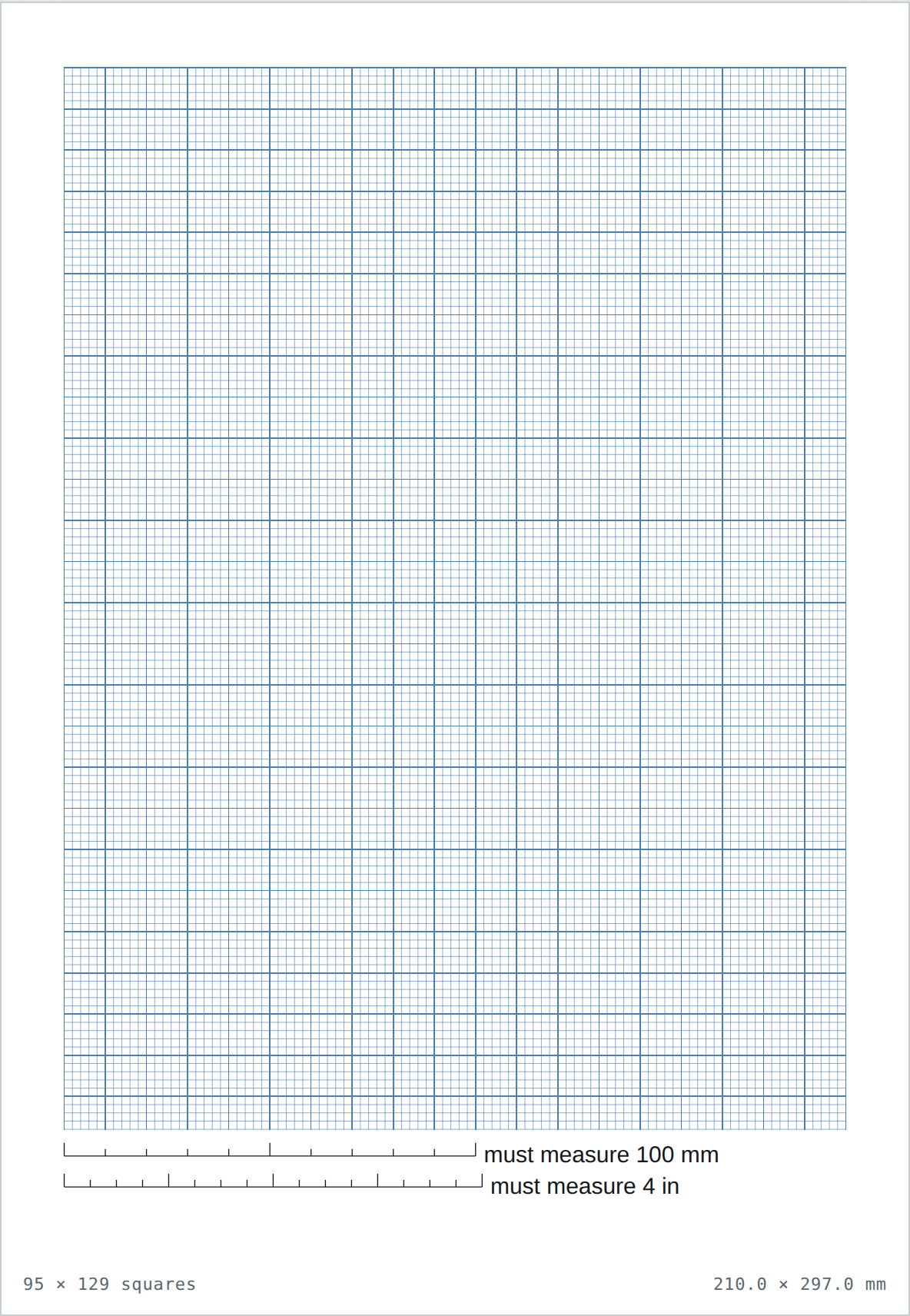
A free 2 mm grid paper PDF, A4 by default and Letter on request. Twelve thousand squares on an A4 sheet. At this density the line colour matters more than the square size does — pick the default blue and you get a usable grid, pick black and you get a page that reads as a solid tint.
What changes when the grid gets this fine
Five squares make a centimetre, so the bold line every fifth square gives 10 mm blocks. The counts below are large enough to be worth stating plainly: an A4 sheet carries over twelve thousand squares and around four hundred and fifty printed lines.
| Paper | With measuring bars | Clean sheet | Grid area |
|---|---|---|---|
| Letter | 97 × 120 — 11,640 | 97 × 129 — 12,513 | 194 × 240 mm |
| A4 | 95 × 129 — 12,255 | 95 × 138 — 13,110 | 190 × 258 mm |
| Legal | 97 × 158 — 15,326 | 97 × 167 — 16,199 | 194 × 316 mm |
| A5 | 64 × 86 — 5,504 | 64 × 95 — 6,080 | 128 × 172 mm |
| Tabloid | 129 × 196 — 25,284 | 129 × 205 — 26,445 | 258 × 392 mm |
Line weight is the real setting on this page. The minor lines are 0.12 mm, which a laser printer resolves cleanly and an inkjet may thicken slightly. If your sheet comes out looking flooded, switch the colour to grey rather than reducing the square size.
What a 2 mm grid is for
Every use here has the same shape: the grid needs to be fine enough to read a value off, and quiet enough to disappear under the work.
Lab and scientific plotting
Fine enough to place a point precisely and to interpolate between gridlines by eye, which is the whole reason fine graph paper exists.
Reading values off a curve
With 5 squares to the centimetre, an intermediate reading can be estimated to a fifth of a small division without guessing.
Fine technical drawing
Detail views and sections where a 5 mm grid would be too coarse to place anything accurately.
Scale modelling
At 1:50, one square is 10 cm of real length. At 1:100 it is 20 cm. Useful for laying out small components without redrawing a scale each time.
Detailed craft charts
Beadwork, fine embroidery and miniature knitting charts where a coarser grid would not hold enough cells to describe the piece.
A quiet background for ink work
Set the colour to grey and the grid guides the hand without competing with the drawing, which the default blue will do at this density.
Sizes 2 mm gets confused with
A tenth of an inch is the near twin here, sitting just over half a millimetre wider. At this scale that half millimetre becomes 50 mm of drift across a single sheet.
| Size | In mm | Against this grid | Where you meet it |
|---|---|---|---|
| 1/10 inch | 2.54 | 27% wider | Engineering computation pads |
| 2.5 mm | 2.50 | 25% wider | Mini Perler and Hama bead pitch |
| 1 mm | 1.00 | exactly half | Millimetre paper, the finest common ruling |
| 1/8 inch | 3.175 | 59% wider | Cross stitch and pixel art charts |
| 4 mm | 4.00 | exactly double | Some continental exercise books |
| 5 mm | 5.00 | 2.5 times wider | The standard metric school grid |
Before you print
Scaling hurts most at this density: a page shrunk by five percent turns a 2 mm square into 1.9 mm, and the accumulated error across 95 columns is nearly a centimetre. Set the scale to 100% or Actual Size, then check the 100 mm bar — it should span exactly 50 squares. The full setting-by-setting guide is on the home page.
Questions about 2 mm grids
Is 2 mm graph paper the same as millimetre paper?
Not quite. Millimetre paper normally means a 1 mm grid with heavier lines every 5 and 10 mm, which is finer again. A 2 mm grid is the practical middle ground: fine enough to interpolate on, coarse enough that a home printer reproduces every line cleanly.
Can I download 2 mm graph paper as a standard A4 PDF?
Yes. The Download PDF button above produces a standard A4 sheet (210 × 297 mm) with 2 mm squares by default, free and with no sign-up. Switch the paper selector to Letter if that is what your printer holds, and set Copies per PDF if you want a multi-page pad in one file.
Will my printer actually resolve a 2 mm grid?
A laser printer will, comfortably. An inkjet on plain paper may thicken the lines slightly, which at this density reads as a tint across the page rather than as individual lines. If that happens, switch the line colour to grey, which is the setting that fixes it.
How many 2 mm squares fit on a page?
On A4 with the measuring bars on, 95 across by 129 down — over twelve thousand squares. Letter gives 97 by 120. Turning the bars off adds nine more rows on either paper.
Why is this PDF larger than the other sizes?
Because it contains far more lines. A 2 mm A4 sheet is around 450 vector lines against roughly 70 for a quarter inch sheet, so the file is a few kilobytes bigger. It is still a fraction of the size of any image-based grid, and it stays perfectly sharp at any zoom.
Is 2 mm the same as 1/10 inch?
No. A tenth of an inch is 2.54 mm, 27 percent wider. On a grid this fine the two look identical side by side and diverge badly over a full sheet, so it is worth checking which one a template or chart actually assumes.
What line colour works best at 2 mm?
Grey or the default blue. Black turns the sheet into a solid grey block from any distance and makes pencil work hard to distinguish from the grid. Red and green are legible but tiring to work on at this density.