Graph paper/1/2 inch
1/2 inch graph paper
Two squares to the inch · also called half inch grid paper · free, true to size, no sign-up
Direct PDF link for sharing or scripts: printgridpaper.com/api/pdf?size=half-inch&paper=letter
Large squares, deliberately. Wide enough for a young hand to put one digit in one box and for a sketch plan to stay readable at arm's length. A Letter sheet holds 285 squares — that is not an error, it is the size doing its job.
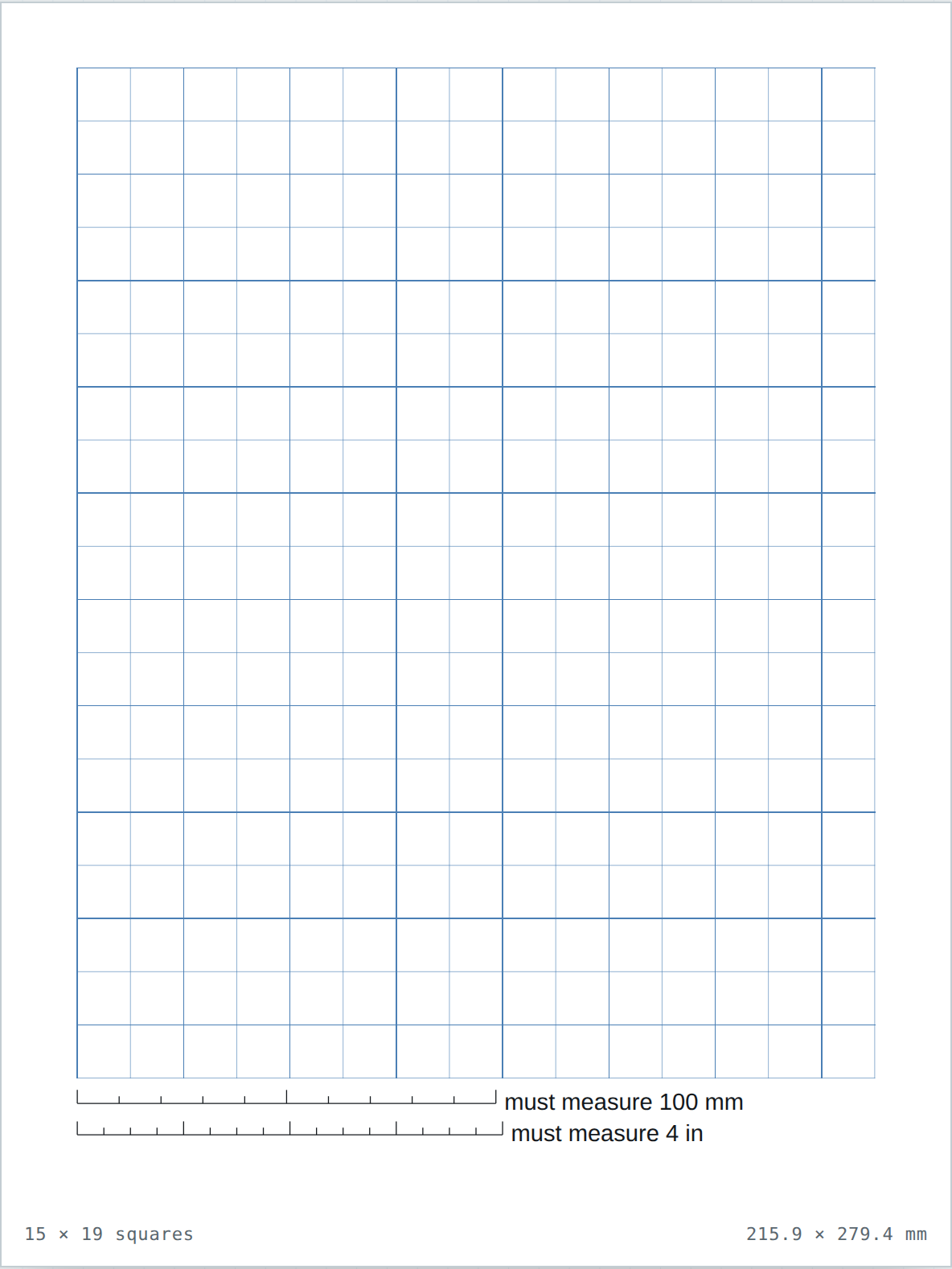
What half inch squares give up, and what they buy
Two squares to the inch means four to the square inch, and the bold line defaults to every second square so each block is one inch. You get roughly a quarter as many squares as a quarter inch sheet, and in exchange every one of them can hold something written.
| Paper | With measuring bars | Clean sheet | Grid area |
|---|---|---|---|
| Letter | 15 × 19 — 285 | 15 × 20 — 300 | 7.5 × 9.5 in |
| A4 | 14 × 20 — 280 | 14 × 21 — 294 | 7 × 10 in |
| Legal | 15 × 25 — 375 | 15 × 26 — 390 | 7.5 × 12.5 in |
| A5 | 10 × 13 — 130 | 10 × 14 — 140 | 5 × 6.5 in |
| Tabloid | 20 × 31 — 620 | 20 × 32 — 640 | 10 × 15.5 in |
A4 loses a column here. A4 is 6 mm narrower than Letter, which is not enough to matter on a fine grid but is enough to drop a whole column when each one is 12.7 mm wide. Big squares make the paper choice visible.
Where large squares are the right answer
The common thread is that something has to fit inside the square — a digit, a symbol, a hand-drawn mark — rather than beside it.
Early maths and place value
One digit per box keeps columns lined up in long addition, subtraction and multiplication, which is where a lot of arithmetic quietly goes wrong.
Handwriting and letter formation
A half inch box is close to the ruling of early handwriting paper, so the same sheet can serve for both letters and numbers.
Large print and low vision
Combined with black lines and the measuring bars switched off, this is the most legible grid on the site for anyone who finds a 5 mm sheet unusable.
Room sketches at 1/2 inch to the foot
One square is one foot at double the usual architectural scale. A Letter sheet covers 15 by 19 feet — one generous room, drawn large.
Quilt block drafting
Coarse enough to draft a block quickly and mark seam positions clearly without the grid crowding the drawing.
Grid games and puzzle prototypes
Board layouts, nonograms and grid puzzles need cells big enough to write in and few enough to count. This is that size.
Sizes a half inch gets confused with
A centimetre is the substitution that happens most, usually because someone had metric paper to hand. It is a fifth narrower, which shows up immediately at this scale.
| Size | In mm | Against this grid | Where you meet it |
|---|---|---|---|
| 1 cm | 10.00 | 21% narrower | Metric primary school grids |
| 12 mm | 12.00 | 5.5% narrower | Occasional imported ruling |
| 1/4 inch | 6.35 | exactly half | US classroom quad ruled |
| 15 mm | 15.00 | 18% wider | Large metric display grids |
| 1 inch | 25.40 | exactly double | Floor plans and tabletop maps |
| 5 mm | 5.00 | exactly two fifths | Standard metric exercise books |
Before you print
Scaling is easier to spot on a big grid, which is the one advantage of working this coarse: a five percent shrink turns a half inch square into about 12 mm and two squares no longer measure an inch. Set the scale to 100% or Actual Size and check the 4 in bar — it should span exactly 8 squares. The full setting-by-setting guide is on the home page.
Questions about half inch grids
Why are there so few squares on the page?
Because each one is 12.7 mm across. A Letter sheet holds 15 by 19 of them with the measuring bars on, against 30 by 38 at quarter inch. Nothing has been cropped or scaled; four times fewer squares is exactly what doubling the square size does.
Is 1/2 inch the same as 1 cm?
No. Half an inch is 12.7 mm, so it is about 27 percent wider than a centimetre and has roughly 61 percent more area. At this square size the difference is obvious the moment you put the two sheets side by side.
Is this a good size for handwriting practice?
Yes, and for number alignment in particular. One digit per box forces columns to line up in written arithmetic, which removes a common source of error that has nothing to do with whether the student understands the method.
Can I use it for a floor plan?
At half an inch to the foot, one square is one foot and a Letter sheet covers 15 by 19 feet — a single large room. For a whole floor on one page, quarter inch to the foot is the standard scale and doubles the coverage in each direction.
Where should the heavy lines go?
Every second square, which is the default and makes each bold block one inch. Set the field to 0 for a plain grid, which is usually better for handwriting work where the bold lines just add visual noise.
Is it suitable for large print or low vision use?
It is the most legible grid here. Switch the line colour to black for maximum contrast, and turn the measuring bars off once you have confirmed the printer setting, so the sheet is nothing but the grid.